
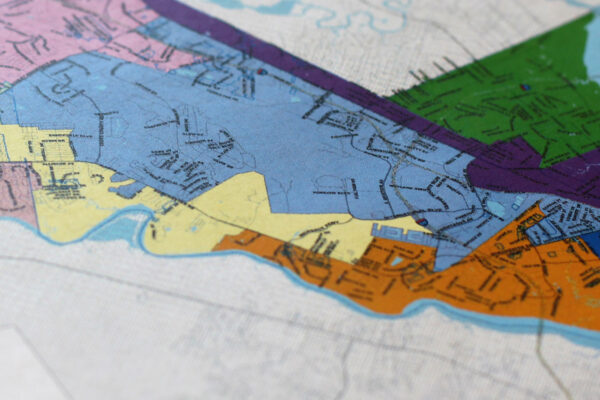

Redistricting is the process of drawing the lines of districts from which public officials are elected. When redistricting is conducted fairly, it accurately reflects population changes and our diverse communities, and is used by legislators to equitably allocate representation in Congress and state legislatures. When politicians use redistricting to manipulate the outcome of elections, however, it’s called gerrymandering — a practice that undermines democracy and stifles the voice of voters. Voters should be picking their politicians. Not the other way around.
In April 2026, the Supreme Court issued a ruling in Louisiana v. Callais, striking down Louisiana’s congressional map that included two districts that allowed Black voters to elect a candidate of their choice. The ruling in Callais eviscerated the part of the Voting Rights Act that prohibited redistricting in a way that diluted the power of voters of color. The ruling opens the door for states to enact discriminatory maps with impunity. As a result, Black voters and other voters of color are facing the elimination of districts at every level of government across the country that have provided fair representation.
In light of this recent decision, Sophia Lin Lakin, Director of the ACLU’s Voting Rights Project, answers some of the most urgent questions about redistricting and voting rights.
What’s the difference between redistricting and gerrymandering?
The process of redistricting is lawful and equitable when it’s conducted properly. It is also frequently a necessary process to reflect population changes after each decennial Census. When redistricting is used as a tool to manipulate electoral outcomes or discriminate against certain groups, it ceases to be lawful and equitable, and we call it gerrymandering.
Redistricting typically happens once a decade, after the decennial census reveals how the population has shifted. That cadence is the norm. Mid-decade redistricting— redrawing the lines between censuses, untethered to any actual change in who lives where—is not.
Prior to the Callais decision, the Voting Rights Act provided an important backstop against gerrymandering that diluted the power of voters of color. In Callais, the Supreme Court changed the standard to bring a claim under the Voting Rights Act that had been in place for decades. It functionally requires challengers to prove intentional discrimination. Now it is close to impossible to make out a violation in the vast majority of cases. This means that states will redistrict without one of the key guardrails that protected the rights of voters of color.
Why bother with redistricting?
The Constitution and the federal courts require it. It's also the fair and equitable thing to do after each decennial Census reveals population shifts and demographic changes. Historically many states did not redistrict to reflect shifts and growth in their populations. In a series of cases in the 1960s, one of which coined the phrase "one person, one vote," the Supreme Court held that the Fourteenth Amendment guaranteed "equality" of voting power and that the electoral systems in states which failed to allocate voting power on the basis of population were unconstitutional. According to the 2020 Census data, nearly all of this country’s population growth this last decade was due to the growth in communities of color. Redistricting is an opportunity to ensure that our maps reflect that growing diversity.
Is redistricting the same as reapportionment?
Reapportionment refers to the allocation of representatives to previously established voting areas, as when Congress allocates, or "apportions," seats in the House of Representatives to the several states following the decennial census. So, for example, based on the population changes captured in the 2020 census, the reapportionment process reshuffled the 435 congressional seats among the 50 states such that certain states like Texas gained congressional seats while some states like New York lost seats. Redistricting is the process of redrawing district lines based on population changes and in some cases may have to take into account a loss or gain of a representative after the reapportionment process.
What is vote dilution?
Vote dilution refers to the use of redistricting plans and other voting practices that minimize or cancel out the voting strength of particular voters, often voters of color. While intentional race-based vote dilution is prohibited by the Constitution and the Voting Rights Act, it is very difficult to prove a state legislature intentionally discriminated against voters of color when adopting a particular districting plan. For decades, Section 2 of the Voting Rights Act filled that gap by prohibiting maps that result in dilution, regardless of whether there is evidence of discriminatory intent. Callais gutted that protection. Without it, vote dilution will continue to diminish the true political strength of communities of color in particular, by fracturing those populations across multiple districts or improperly concentrating them together in a single district. Again, the 2020 census shows that nearly all of the country’s growth over the past decade is attributable to the growth in our nation’s communities of color. Redistricting plans should reflect that reality.
How can we make sure redistricting is conducted fairly?
We all need to be involved in the process. We should stay informed of plans to redraw federal, state, and local district lines; attend meetings where plans are presented and evaluated; contact organizations willing to evaluate proposed plans and offer alternatives; write letters of support or opposition to elected officials and the Department of Justice; and seek needed legal advice. The goal of redistricting is to provide fair and effective representation for all. We can help achieve that goal by actively participating in the redistricting process.
While the Supreme Court’s decision in Callais sharply limits federal voting rights protections, advocacy and enforcement efforts will continue through legislative action, U.S. and state constitutional and state voting rights act claims, and other available legal avenues.