
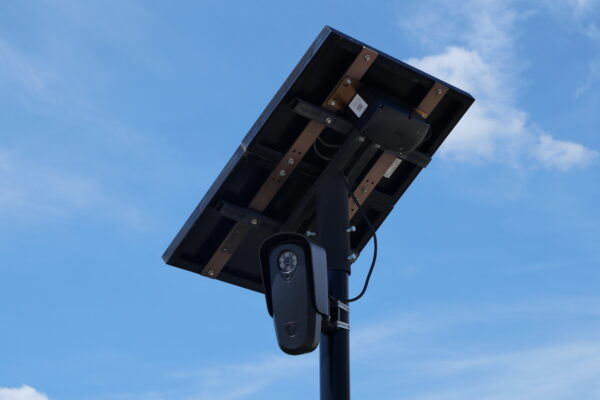
By now, you’ve likely noticed them affixed to various streetlights along major roadways, the small black cameras accompanied by a solar panel: Flock cameras and other automated license plate readers (ALPRs).
Once you start noticing them, you begin to realize just how omnipresent they are. You’ll see them when you’re driving to the grocery, to your doctor’s office, or to work. You may begin to have the uncomfortable feeling that you’re being watched.
Those who refuse to be concerned about an ever-expanding surveillance state often offer a simple retort: “If you’re not doing anything wrong, why do you care?”
Those who have been following the news related to ALPRs understand this is, unfortunately, not reflective of reality. According to Eyes Off Indiana, there have been more than 17,000 searches of individuals who were not under investigation. There have been 10 documented cases of police misuse of license plate cameras in our state.
Of the 10 cases, only half were caught by the department itself. That’s not a comforting statistic, particularly in a field where accountability and transparency have often fallen short.
If you need a reminder, here’s a look at those documented cases in Indiana so far:
Some of these instances of misuse were discovered during routine audits of ALPR searches by officers. However, there’s currently no state law mandating these audits, so we’re left trusting departments to do so voluntarily.
That’s not good enough.
How many other cases of misuse have gone undiscovered?
When considering this lack of oversight, I can’t help but think of a personal anecdote.
When I was a teenager, my uncle gave me a butterfly knife. It probably wasn’t a good idea to give a 15-year-old such a precarious tool, the very nature of which begs to be played with.
Well, fast forward just a couple weeks and, unsurprisingly, I cut myself while absent-mindedly fiddling with it. The cut was pretty bad, too. I probably should have had stitches, but we did our best with the at-home first-aid kit. I still bear the scar on my thigh from that lapse in judgement.
Do you know what my mother did after that happened?
Aside from what I imagine was a very uncomfortable conversation with my uncle, she took it away from me. I’d proven I couldn’t be trusted with it.
State and municipal authorities need to exercise the same judgement against law enforcement agencies who have demonstrated, time and again, that police cannot be trusted to police themselves when it comes to Flock cameras and other ALPRs.
Here’s how it works in another industry, specifically in the case of medical malpractice.
Of course, if you suffer as a result of medical malpractice, you can always take civil action to seek restitution for pain and suffering. However, there’s also the Indiana Medical Board, which offers a level of independent oversight outside the hospital or medical center’s own disciplinary structure.
The board is a part of the Indiana Professional Licensing Agency (IPLA), which supports various occupational licensing boards, commissions, and committees “charged with the responsibility of holding administrative hearings to potentially impose disciplinary sanctions on licensees who have violated practice standards, acted dishonestly, or acted unethically.”
The IPLA has a presence across a host of other professions, from athletic trainers to auctioneers, barbers, plumbers, real estate agents and more.
There are some forms of police oversight in Indiana, such as civilian oversight boards, but recent legislation has dulled their teeth.
Senate Bill 284, which became law this March, ensured these boards “or any other entity established by a county, municipality, or township to provide civilian oversight over a law enforcement agency” could only act in an advisory role, without “binding authority” over the agency.
The law does make exceptions for merit boards and commissions, but law enforcement is a field that could use more oversight, not less. That’s particularly true as new, powerful technology is introduced into their departments.
It’s also a known issue that technology often outpaces our laws, and it’s a tried-and-true practice by tech companies to seek forgiveness rather than permission, see Uber.
—A disruptive service can be created by a couple of geeks with laptops, but new laws are born within the snarl of slow bureaucracy. It takes a while for them to catch up.
But in the case of ALPRs, the stakes are far too high. The potential for abuse by authorities appears too tempting, too commonplace. Even without these instances of misuse, the erosion of privacy and civil liberties these cameras represent is beyond concerning.
Indiana’s legislative session is right on the horizon, and our lawmakers need to address this issue before more harm is done. At the very least, we should be demanding the same oversight and safeguards against misconduct that we see in other industries.
This is not only the right thing to do, but it’s also the popular one.
Cities around the state have been ending their contracts with Flock as citizens make their opinions heard on what they see as an expanding surveillance state.
For more information on Flock cameras and our Get the Flock Out initiative, including ways to take action in your community, visit our campaign page.