Update: Language discussed in this blog from SB 199 has now been added to House Enrolled Act (HEA) 1408. More information on this bill and our opposition can be found here.
Social media has become a favorite topic at the Statehouse this year. Lawmakers have already introduced a wave of bills that would make it harder for young people — and in many cases, all Hoosiers — to log on at all.
The intention is understandable; we all want kids to be safe online. But in practice, this bill leads to restrictions on protected speech and access, and it places government at the heart of deciding what families can and can’t choose for their own kids.
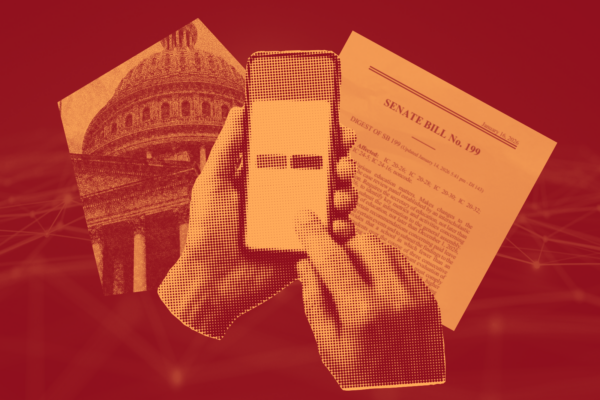
That’s why Senate Bill (SB) 199 (HB 1408 now), currently under consideration by legislators, raises serious red flags.
What the Bill Would Do
SB 199 is a broad education bill, but tucked inside it lies Section 10, which contains a major set of rules aimed at restricting social media access. Here’s the core of what it would do:
- Require age verification and identity checks for everyone. This section doesn’t just apply to minors. It would require all Indiana residents, including adults, to verify their age to create or even maintain a social media account.
- Teens would need parental consent, for any type of access. It would require explicit parent consent for adolescents between the ages of 14 to 17 to create/maintain accounts on platforms, regardless of the scenario or content. Anyone under the age of 14 is prohibited from having an account at all.
- Impose a government-mandated “curfew” for adolescent users. The bill also limits when adolescents, who receive parent approval, can access social media. This treats young people’s ability to participate in lawful speech like a privilege the state can switch on and off by the hour.
Taken together, the bill’s language doesn’t truly protect kids online, but it does raise serious constitutional concerns.
Access and Privacy Concerns
This bill doesn’t just change what teens can access online. It changes what all Hoosiers would have to do to participate in digital life. By requiring age verification from every Indiana resident to create or even maintain a social media account, SB 199 effectively makes identity checks a condition of speech.
Age verification is not a simple checkbox. It often routes users through mobile credentials, government ID scans, document submission, or use of third-party vendors. These systems burden access to protected speech and create privacy concerns that discourage people from participating.
In addition to those concerns, age verification is impractical. Many people don't have a government-issued photo ID or other documents that might be used to verify their identities. This is true for Hoosiers of all ages.
The First Amendment Protects Young People, Too
One of the key arguments against this policy is also one of the simplest: the First Amendment protects young people as well. The Supreme Court made this clear in Brown v. Entertainment Merchants Association (2011) when it struck down a California law that barred minors’ access to violent video games. In its ruling, the Court acknowledged that the state has a legitimate interest in protecting adolescents from harm but emphasized that this interest does not give broad authority to determine access to lawful expression and speech.
—Speech that is neither obscene to youths nor subject to some other legitimate proscription cannot be suppressed solely to protect the young from ideas or images that a legislative body thinks unsuitable for them.
Justice Antonin Scalia
In April of 2025, a U.S. District Court ruled that Ohio's Parental Notification by Social Media Operators Act, which would require parental consent for minors under 16 to access social media, violated the Constitution. In its decision, the Court stated that “Minors’ access to information is essential to their growth into productive members of our democratic public sphere.” (NetChoice LLC v. Yost). Ohio appealed the ruling, and the case is now pending in the 6th Circuit.
Social media, although deserving of certain criticisms, contains vital content; it’s where young people read the news, learn about current events, engage with art and culture, find community, and participate in civic life in 2026. A law that blocks or prohibits access to those ideas, simply because minors might encounter content some lawmakers wish they didn’t, crosses the line from protection to censorship.
Parental Rights and Government Overreach
When someone hears that this bill requires “parental consent,” they may assume that SB 199 is giving families more control. In reality, Section 10 of this bill doesn’t offer parents anything; it mandates a single approach for every family in Indiana, regardless of the child’s maturity, needs, or circumstances.
This bill doesn’t give parents the right to restrict their minor children's access to social media. Parents already have that right. The government does not.
Ultimately, the issue sits at the heart of two core principles: young people are entitled to free speech, and parents have the right to direct their children’s upbringing without unnecessary government intrusion.
Where We Go from Here
Hoosiers don’t have to choose between protecting kids online and defending the Constitution. We share the same goal: young people deserve safety, support, and healthy digital spaces.
Indiana can promote online safety and support parents without mandating a one-size-fits-all solution for every household. Progress should start by focusing on solutions that respect free speech: increasing digital literacy, investing in evidence-based ways to protect youth online, and supporting tools that families can choose.
The stakes are high, and as a state, we must maintain our constitutional rights to free speech and privacy. At this time, SB 199 has passed out of committee and is onto the Senate floor. We urge legislators to reject SB 199 and pursue approaches that keep kids safer online without restricting protected speech for all Hoosiers.