As our country marks 250 years of independence, the U.S. Supreme Court has concluded a profoundly consequential term for civil liberties and constitutional rights. We saw the court take up fundamental questions involving citizenship, voting rights, and more.
During this term, the ACLU brought five merits cases before the Court and filed amicus briefs for several other cases, contributing to widespread changes nationwide and in Indiana.
Here are some of the biggest takeaways and what they mean:
Birthright Citizenship: The Constitution Still Means What It Says
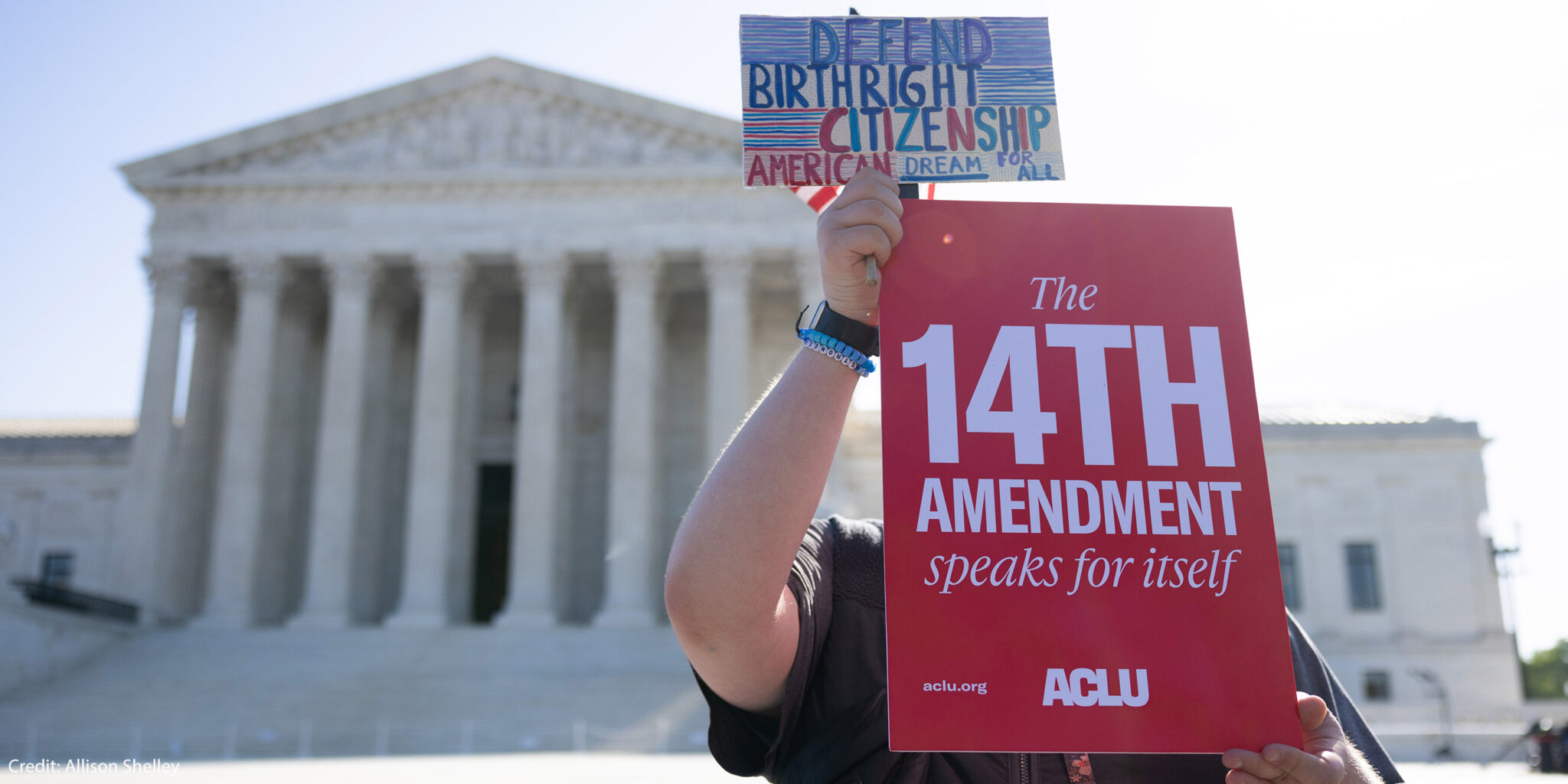
The Issue: In a landmark case over the promise of birthright citizenship — long found to be guaranteed by the Fourteenth Amendment — Barbara v. Trump was filed as a class action in response to President Trump’s 2025 executive order attempting to restrict birthright citizenship, which would have impacted countless Americans.
The Ruling: On the final day of the term, the Court struck down the executive order in a 6-3 decision, reaffirming that birthright citizenship is guaranteed by the Constitution and can’t be redefined through a president’s executive action.
What This Means for Indiana: This ruling means that those born in Indiana and across the U.S. will continue to receive citizenship and the legal protections that come with it, regardless of their parents’ immigration status. This was a historic win for preservation of an indelible right afforded by the Constitution.
Voting Rights: Dismantling Section 2 of the Voting Rights Act
The Issue: Following the 2020 census, Louisiana’s revised congressional map was found by a court to likely violate Section 2 of the Voting Right Act, as the map only included one majority black district of six, despite one-third of the population in Louisiana being Black. After the state legislature passed a new map with a second majority-Black district, a group of white voters challenged it as a racial gerrymander under the Fourteenth Amendment, leading to Louisiana v. Callais.
The Ruling: In a devastating 6-3 ruling, the U.S. Supreme Court struck down the congressional map, essentially eviscerating Section 2 of the Voting Rights Act and opening the door for states to pursue discriminatory maps. The majority treated Louisiana’s effort to remedy vote dilution as unconstitutional discrimination, making it significantly harder for voters to challenge maps that weaken the political power of communities of color.
What This Means for Indiana: This past December, the Indiana Senate defeated an unprecedented attempt to redraw our congressional map mid-decade. However, this ruling leaves Black Hoosiers and other communities of color with strictly narrowed federal protections against maps that dimmish fair representation. As we look ahead, we must continue pressuring lawmakers to reject any future attempts to undermine fair representation through partisan gerrymandering.
Trans Sports Bans Upheld, but a Limited Ruling
The Issue: The Court heard two challenges to state transgender sports bans. Little v. Hecox involved an Idaho university student seeking to participate in college club sports. B.P.J. v. West Virginia involved middle schooler Becky Pepper-Jackson, who sought to join her school’s cross-country and track teams. The cases challenged the bans under the Equal Protection Clause, with B.P.J. also raising a Title IX claim, which prohibits sex-based discrimination in education programs, including athletics.
The Ruling: For the second term in a row, the Court ruled against the rights of trans students, determining 6-3 that the Idaho and West Virginia laws do not violate the Equal Protection Clause. The Court unanimously rejected the Title IX claim, though three justices disagreed with parts of the majority reasoning.
What This Means for Indiana: The Court’s ruling was limited to girls’ and women's sports, and Indiana already has a K-12 and college ban targeting trans women and girls. The joint ruling strengthens these anti-trans sports laws, making it more difficult to challenge them under Title IX and the Equal Protection Clause. The ruling does not decide whether schools may exclude transgender students from bathrooms, locker rooms, classrooms, or other programs and facilities. Watch our webinar for additional details.
Immigration Status: Temporary Protections Face Uncertainty
The Issue: Several cases considered the federal government’s ability to restrict protections for people seeking safety in the U.S. Mullin v. Al Otro Lado challenged the practice of “metering,” where border officers blocked asylum seekers from ports of entry and forced them to wait in dangerous conditions. Mullin v. Doe (as well as Trump v. Miot) challenged the termination of Temporary Protected Status (TPS) for hundreds of thousands of Haitian and Syrian immigrants.
The Ruling: In two devastating decisions, the Court upheld the harmful policies. In Al Otro Lado, the Court allowed the government to reject asylum seekers before they crossed the border. In Mullin v. Doe and Trump v. Miot, it allowed the administration to end TPS for Haiti and Syria, placing individuals with TPS at risk of losing legal status and work authorization.
What This Means for Indiana: There are an estimated tens of thousands of Haitians who have built their home here in Indiana who could lose legal status, facing detention or deportation. The decision also isn’t limited to Syrian and Haitian TPS holders — it threatens the status of individuals from 17 countries (around 1.3 million). Read more about country-specific TPS updates from U.S. Citizenship and Immigration Services here. Learn more about legal services for immigration here.
More information on the status of TPS for your country can be found on the U.S. Citizenship and Immigration Services or E-Verify website. For legal assistance, visit Exodus Refugee or the National Immigrant Justice Center.
Here, we examined just a fraction of the 68 rulings SCOTUS made during the 2025-2026 term. The court examined additional cases that will have reaching impacts, from ruling against a Colorado law that prohibited conversion therapy to minors in Chiles v. Salazar to limiting sweeping location data collection by geofence warrants under the Fourth Amendment in Chatrie v. United States. Here in Indiana, the state Supreme Court also left a ruling intact that protects the confidentiality of Terminated Pregnancy Reports (TPRs), safeguarding private patient information and shielding physicians and patients from harassment.
As the fight continues, we’re not going anywhere. The ACLU of Indiana will keep showing up to defend the rights of all Hoosiers and push back when they are threatened.